
Climate Column: Finding the Gifts of Life in the Humblest of Places
NATASHA JULIANA
ARGUS-COURIER COLUMNIST
March 23, 2026
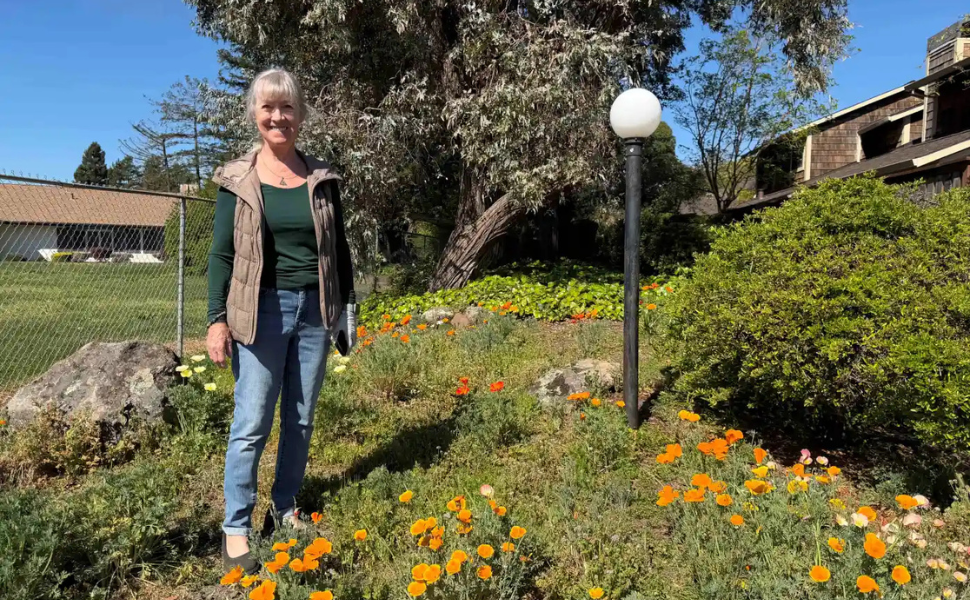
Diana Scranton stands in a California poppy patch that replaced a bed of ivy. She says the ivy had been a common place for littering, but now that it’s converted to flowers people don’t toss their trash there anymore.
What do fallen trees, puddles, piles of leaves and messy native grasses have in common? They all create habitat.
Recently, I was treated to a tour of the nature trail snaking along the edge of campus at Mary Collins School at Cherry Valley. We were given the same “Biodiversity Check-up Checklist” they use to teach children during the Petaluma City School’s Environmental Literacy and Climate Action meeting. It became a fun game of trying to find each element that would help wildlife thrive, including “complexity,” described as areas that looked messy with varied textures and heights. We all left feeling inspired to create complex habitat gardens in our own neighborhoods.
This simple experience invited me to pay more attention to the array of inspiring landscape transformations I encounter through my work as the director of the grassroots nonprofit Cool Petaluma. Have you noticed how people light up when they start talking about their gardens?
Our climate book club recently read “Carbon: The Book of Life” by Paul Hawken. Framed like a biology lesson, this book made us fall more deeply in love with our miraculous planet. During the discussion, Sue Schildt shared how her tiny plot of dirt was transformed into an oasis of life with the help of Luma Front Yard Farming (they do back yards, too). The joy and pride she felt in shepherding this regeneration of nature was contagious.
What had been a barren plot was now full of food for humans and wildlife alike. It took a few months for the birds and bees and butterflies to find her, but now, Schildt’s yard is a frequently visited island of abundance. “By the end of the summer, I probably harvested over one hundred pounds of tomatoes,” she boasted. (Pro tip she learned from Luma Front Yard Farming: slugs don’t like wool. To help a plant plagued by slugs, simply surround the base with this natural fiber.)
Council Member Karen Nau is one of our trained Cool Team leaders, and when dropping off materials to get her block started, she gave us a tour of her garden.
Nau’s front yard was in the process of evolving from lawn to habitat. Starting at the edges, she had added edibles, like artichokes and thyme, and pollinators, like milkweed. “I’m hoping the monarch butterflies will find them,” Nau said. She noticed the milkweed was being attacked by aphids, so she brought home two containers of ladybugs to take care of the problem. We watched as they crawled around on the plant, hard at work rebalancing the system.
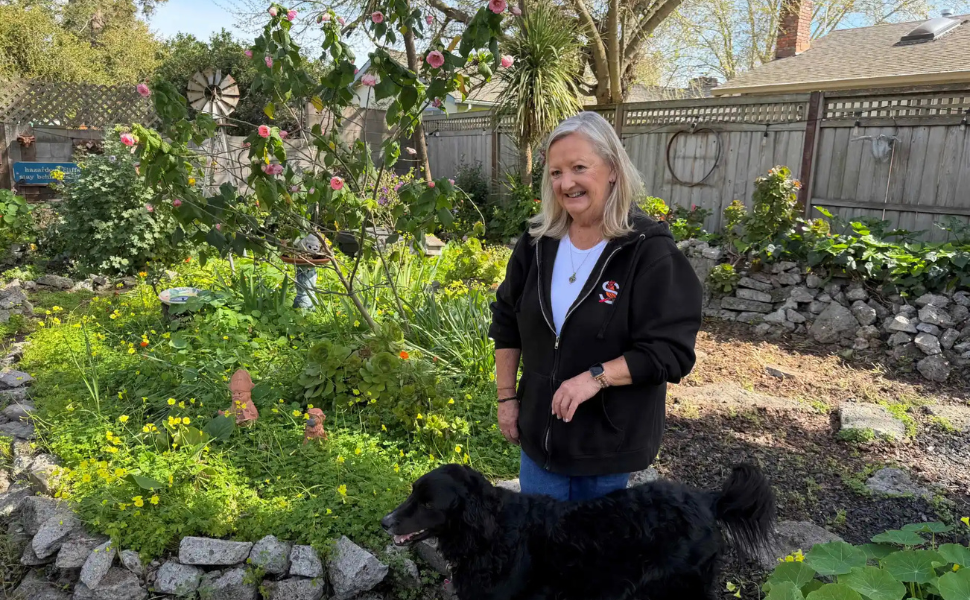
Councilmember Karen Nau in her backyard.
Nau’s backyard was a jungle of shrubs and flowers growing in raised beds made of the rubble from the removal of the original concrete that had covered much of the space. A small water feature provided a drink for thirsty birds and bees. And the mulched paths that meander through the foliage provided endless play spaces for her grandchildren.
On a larger scale, the HOA at Creekview Commons has also embraced biodiversity by restoring landscapes. Resident Diana Scranton is a member of the grounds committee that worked on revising HOA Rules & Regulations. “In 2012, I attended a permaculture course with Daily Acts and was so inspired, I wanted to create something more environmentally friendly here,” Scranton explained.
It took several years to revise the HOA regulations, but now homeowners can plant anything they want in the areas adjacent to their homes, as long as it is water-wise, noninvasive, and doesn’t exceed six feet. They also banned the use of toxic chemicals like Roundup.
The Monroe Street islands that run along the front of Creekview Commons are now a beautiful corridor of plants that are drought-tolerant, provide beneficial habitat, and are primarily native. Scranton found it “wonderfully interesting to discover how each plant serves our neighboring wildlife.”
In the fall of 2024, Scranton attended the ReLeaf Petaluma information session that Cool Petaluma hosted. When the Creekview Commons 72-unit development was first built, there were over 300 trees on site. But over the years, many had been lost. She asked if they could get one of the free ReLeaf residential trees, and to her amazement, the complex was offered 40 native trees for the property. “It was such a wonderful gift,” Scranton recalled.
We live on the most beautiful planet. Humans continue to search the heavens, but we have yet to find any signs of other life, let alone the complex abundance we enjoy on Earth. We often describe “nature” as something separate from ourselves, but every breath of oxygen, every morsel of food, every sip of water proves human life is an inextricable part of the natural world.
As I write this, the temperature is 25 degrees above average in Petaluma, while blizzards and floods wreak havoc elsewhere. With climate chaos upending the traditional weather patterns that life on Earth has grown accustomed to, we humans are called to help correct the course. We must stop burning fossil fuels, stop deforestation, stop factory farming, and go all in on helping nature restore balance. Tending a garden that supports the profound gifts of life can be a first step.
As Hawken explains in “Carbon,” “Our relationship to the biosphere will determine what lies ahead for humanity. Bending the arc away from blatant degeneration toward ecological recovery depends upon knowledge and respect for the world of plants.”
Natasha Juliana is Campaign Director for Cool Petaluma. She can be reached at natashaj@coolpetaluma.org.